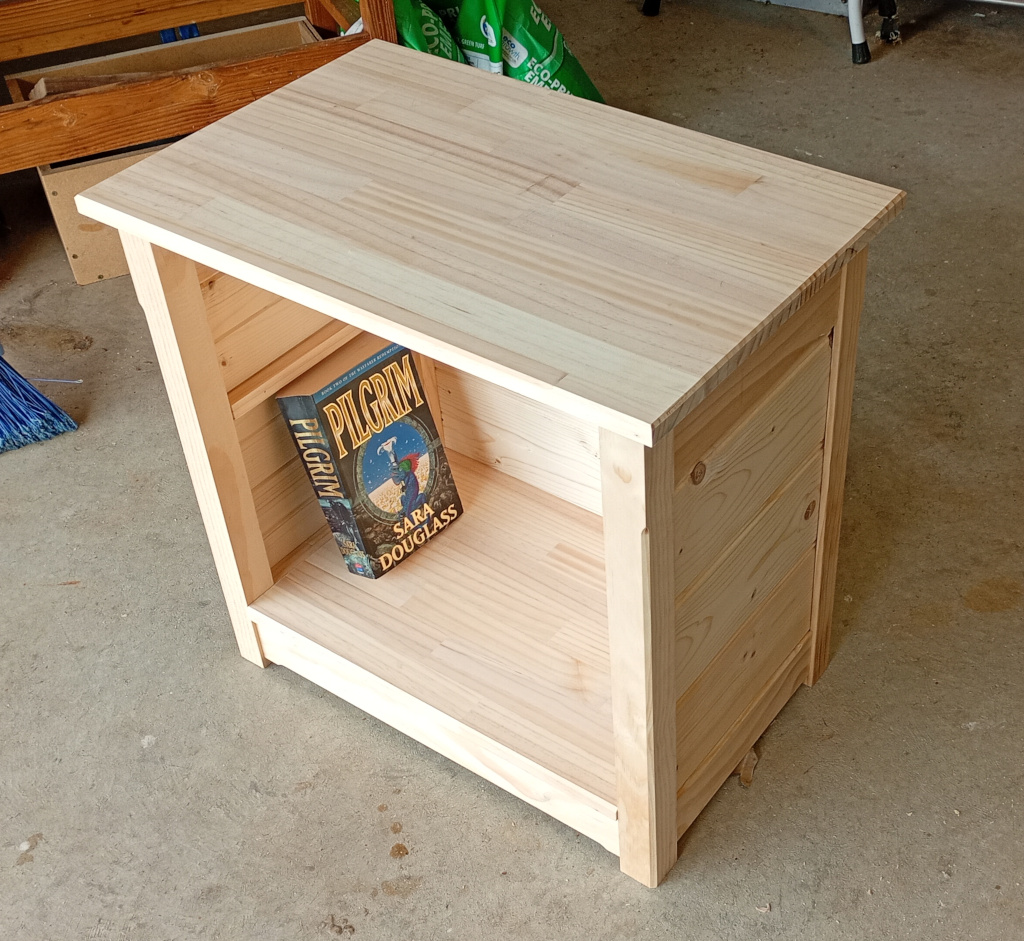
When Mum went into hospital and it was looking like we’d need to shuffle furniture around, she asked me to put the sofa in my room up for sale and move her recliner there in its place. I did that and immediately found the room was half empty. Plus, the recliner doesn’t have arms you can sit things on, so I needed a chair-side table or something. I already had a length of pine shelving and some other lengths left over after doing the kitchen so after putting it off for a while I decided to get the rest of the timber and have a go.
I have a pretty well practised method for making furniture that involves modeling it in Blender and then following the same base pattern, which is to use 45mm square timber for the legs, 19×90 or 19×65 lengths for the frame and the composite pine shelving for the surface. I’ve used the technique fairly successfully in the past. This time, however, I decided to make the project into a little bookcase.It would not be an open frame, but a table with enclosed sides, a lower shelf and a middle shelf. That made it complicated.
I wanted to use 133x12mm spruce paneling to fill in the back and sides of the bookcase, so that meant cutting trenches down the sides of each of the legs. That was easy enough with the router but I also had to do some extra routing work to get the top and bottom frame pieces to fit into the legs as well. Cutting out the lengths of timber went well enough until I started assembling the bookcase.
I guess the real issue was that I hadn’t thought through the assembly as well as I should have. The total height of the spruce paneling was just a little shorter than I planned for, which meant the legs were too tall at the top. I solved that problem by adding some timber shims to fill the space between the top of the frame and the tabletop. But I’d also assembled the frame and sides so that the whole thing was slightly wonky, possibly because the mortises I had cut may or may not have been exactly in the same position. I also got into difficulties trying to mount the bottom shelf, partly because of the different widths introduced by the transition between 19mm frame and 12mm paneling, but also because of complications with the front bottom framing piece. I’d cut the mortises too long, so I needed to position the bottom shelf just so to cover up that mistake and, you know. I made a few rookie errors.
Like cutting the bottom shelf too narrow so that I had to add strips on either side to fill in the gaps, then using a piece of scrap timber to hammer in one of those strips, thereby leaving a collection of nasty dents in it.
The upshot of it all was that the second half of the construction process was dedicated largely to solving a series of problems that were the result of earlier poor decisions. And I ran out of wood for the upper shelf. The effect was that I found myself struggling with this project. For a good part of the build I felt that I was on the back foot and not at all sure that I’d end up with something that I’d be happy with. It was only when I’d solved the problem of mounting the bottom shelf and patching the gaps that it began to turn around.
But against all odds, if you don’t look too carefully, it’s not a bad design. Sure, it ain’t square where it should be, and there’s probably too many little pieces of timber holding the big pieces of timber in their place, but it looks nice. I’ll sand it down tomorrow and give it a spray and one day I might even make the top shelf.
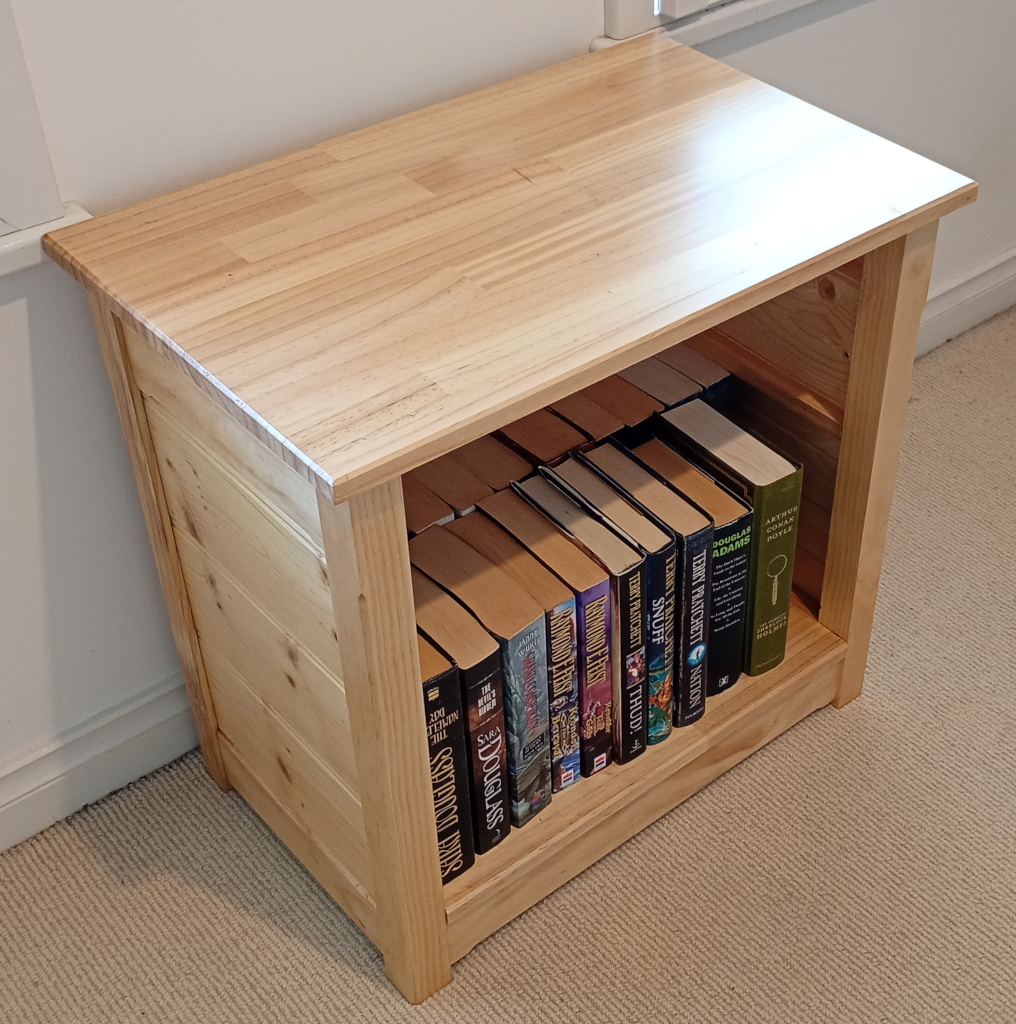
And here it is after a few coats of estapol. I’ve found that getting a good surface on the top is really tricky with a brush. I tried a couple of times and finally gave up and got out the paint sprayer. The first application was super heavy and super dirty and I messed it up trying to pick out a lump of something, so I wiped it all down and had another go. Much better.
I still need to get some timber for the top shelf, which will sit in place, but I think it came out alright and it’s short enough to not impede the window shutters.