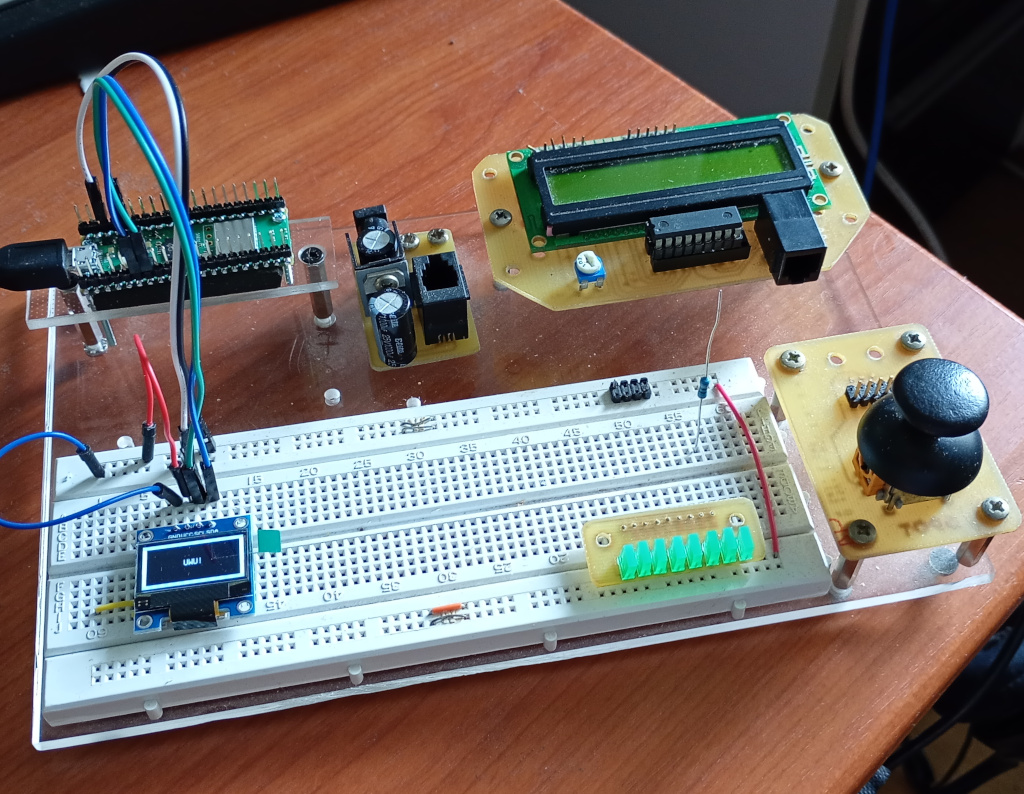
For a few years now I’ve had a collection of breadboarding modules that I’ve used for prototyping. They’ve all had an Arduino Uno mounted in the top corner.
Since I started using Raspberry Pi Picos, I came to the decision to replace one of the Arduinos with a Pico. So when I received my latest order I thought this was the perfect time.
Mounting the Pico, as always, was the main challenge. I first started with a piece of polycarbonate. Cutting it to shape and drilling it to fit on the spacers I already had installed went well enough, till I tried marking out the mounting holes for the Pico. It was then that the scriber I was using cracked the sheet in half and stabbed me in the hand.
Back to ye olde drawing board.
It was getting late and I was on the verge of giving it up for the night, not wanting to be marking out and sawing large chunks of plastic, when I saw the offcuts from the robot bump sensors. They were too thin to fit on the existing spacers, but big enough to fit a Pico.
I drilled one of the bits of plastic with mounting holes at either end and countersunk them so the screw heads would not protrude and interfere with the USB cable. Then I drilled new holes in the base and fitted the carrier to the base.
All of this was only possible because I’d already decided to screw the Pico onto the carrier using some 2mm machine screws I’d had for ever.
I marked out the mounting holes for the Pico, one at a time. In the end I only drilled 3 holes because it’s fine. I didn’t want the Pico crushed against the carrier so I stuck some self adhesive foam on the top of the carrier to cushion it.
I sat down and soldered header pins on one of the Picos and then set about fiddling with the diminutive nuts and bolts. Now I have a test bed for Pico development. The picture at the top shows the Pico in the top left. Then there’s a 7805 power module and a legacy LCD module. Most of the space is devoted to the breadboard itself, while an old X-Box (?) controller joystick takes up the bottom right.
The new setup works pretty well, but when plugging wires into the Pico, the foam has the tendency to squish, so I might need to investigate an alternative.
Other than that I’m pleased with the result.