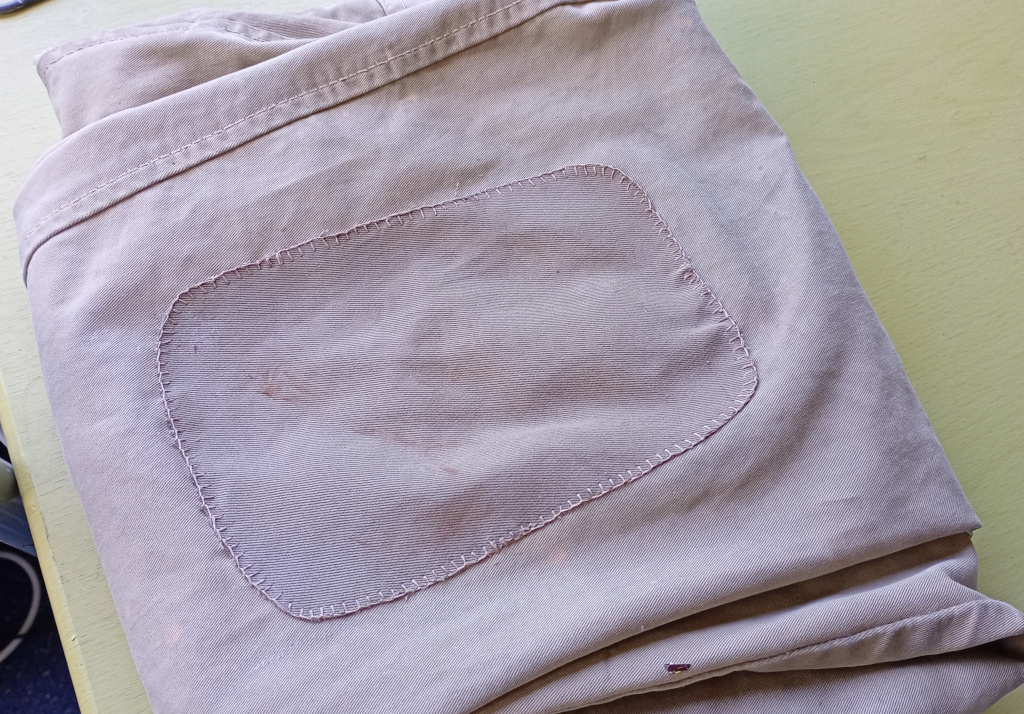
Well, kinda jeans, trousers. I’ve got this pair of old work trousers that I’ve been using for garden work for the last 6 months or so and the knee finally started blowing out. Normally when this happens I ignore it until it’s completely destroyed but this time I thought I’d try a different approach.
I rescued some cloth from a different pair of trousers that I had ruined and cut up for rags in the garage. In fact, I’d already used the cloth to wipe up some oil or other, but there was still a good amount of clean cloth. After washing the cloth I took a piece of paper and cut out the shape of the patch I wanted. Since the knee wear area is quite large I decided to cover the whole knee section.
I traced around the template onto the back of the patch fabric and then cut it out. To hold it in place I elected to use glue stick glue, since the cloth was cotton. Then I had the task of sewing the patch on.
I wanted a stitch that would secure the edges of the patch as well as hold it to the leg of the garment and went with a blanket stitch. Now, I don’t know anything about sewing so maybe I made a mistake. It just seemed to me that the blanket stitch would secure the edges of the patch without having to hem it first. We shall see. In any case it took me a few hours, on and off, to sew around the edge of the patch. My biggest frustration was, using a doubled thread, it would twist and tangle itself into a tiny knot that wouldn’t let me draw the thread through without leaving a loop on the inside, so I had to be careful that the stitch was made completely. Also, getting the tension on the stitch was also a bother, with one hand inside the leg.
Positioning the needle for the stitch from inside was also a bit of a problem until I discovered that I could run the tip of the needle along the fabric and watch the dimple move as I zeroed in on the point where I wanted the thread to pass through. That saved a lot of time.
At long last I got to the end of the job and tied off the last bit of thread. Thoughts? The job is, well I wouldn’t say high quality but considering it’s my first patch job, it’s not terrible. It’s a little uneven and maybe could have been a bit closer. Perhaps I could have used the sewing machine, except to do that I’d need to refamiliarise myself with its operation. I could also have done some more reading on how to sew on a patch. Actually that might have been useful. At any rate, I have a patched pair of pants and we’ll see how my work holds up in actual use.