There’s any number of ways to keep a track of your budget but I don’t care about apps and all that, screw that nonsense. Remember when Microsoft Money was a thing? Never used it. One thing I have tried using over the years is the humble spreadsheet.
I’ve had budgeting spreadsheets since the 90s and the two features common to them all are optimism and not actually being followed. Actually, I tell a lie. In the 20 teens I developed a budgeting spreadsheet that kind of worked for a while.
Some time in 2025 I loaded up the old spreadsheets and figured that maybe I could adapt what I’d developed to suit my current situation and a need to plan ahead.
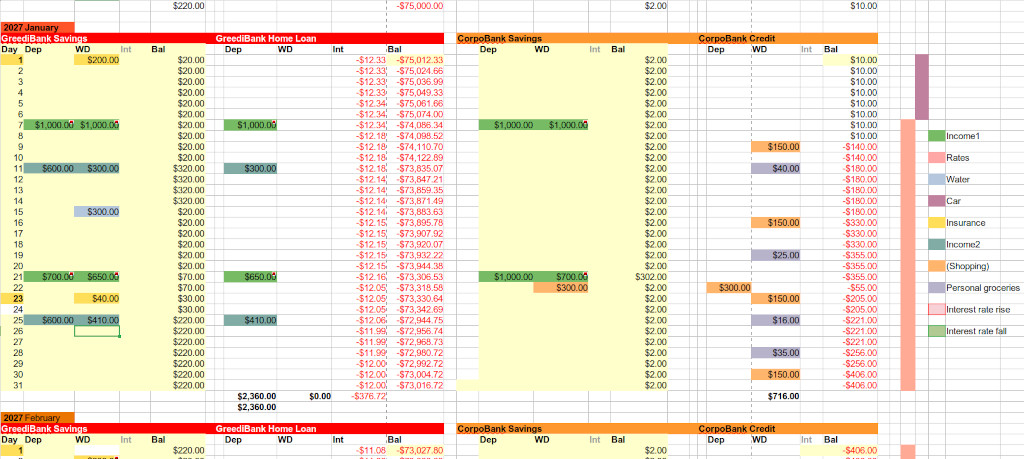
My theory for the spreadsheets is to have an entire year planned out on one sheet, starting in January and organised by months. Each day is represented by a row and each month is displayed in a block. Simple so far.
As for the columns, I have 4 main sections. On the left side are two bank accounts, a savings and a home loan, from one bank and on the right I have 2 other accounts, a savings and a credit card.
For each of the accounts I have 4 columns, corresponding to credits, debits, interest calculation and balance. The interest calculations add or subtract to the balance for each day according to the interest rate for that account. In practise I only use the interest column for the home loan. The balance entries take the previous day’s balance and add the credits and interest and subtract the debits.
It’s all pretty straightforward.
When I set up the sheet for the year I add in all the sources of income, based on projections, bills including car rego, insurance, rates, water, living expenses and so on. I also include a monthly discretionary spending amount which, to be clear, I haven’t kept to yet.
These items are further organised by the use of colour coding, so that I can see at a glance the category of each otherwise anonymous entry. Adding comments also helps here but I have had a couple of times when the comments have vanished, so I don’t rely on the commenting system.
In use, the spreadsheet allows me to track funds coming in, transfers, expenditure and so on. It has also allowed me to see the whole year ahead of time, so as long as I follow what’s on the sheet I have a pretty good idea of what my finances should look like, barring the unforseen. And also barring me buying things that are not planned for.
The method has its limitations. Firstly, it doesn’t keep a track of transfers. That has to be done manually. If I transfer money from one account to another I have to make sure to show it in the corresponding column. It’s otherwise easy for money to vanish from the spreadsheet or appear out of thin air.
Also, it’s difficult to show the direction in which money is moving. If I transfer money from one bank to another, and then from one account to another, I can show that these quantities are related with colour coding, but comments are needed to show exactly what is happening.
The other main shortcoming is that each day only has one cell per transaction. If I spend money for two different reasons from the same account on the same day, such as shopping and paying a bill, it’s tricky. I get around this by recording different transactions on the next day. So for example, if on Monday I go shopping and pay a bill, I might put the bill on Monday and use Tuesday to record the shopping. That way I can colour code each transaction and it isn’t really important that transactions show up on the wrong day.
There’s more to the spreadsheet that I haven’t mentioned, like strategically managing credit card repayments and integration with my shopping budget but maybe I’ll discuss that later.
Overall, I think the strategy is working. I have a pretty tight view of the state of my finances and I have the ability to look forward to the end of the year and beyond to make sure I stay on the right track.