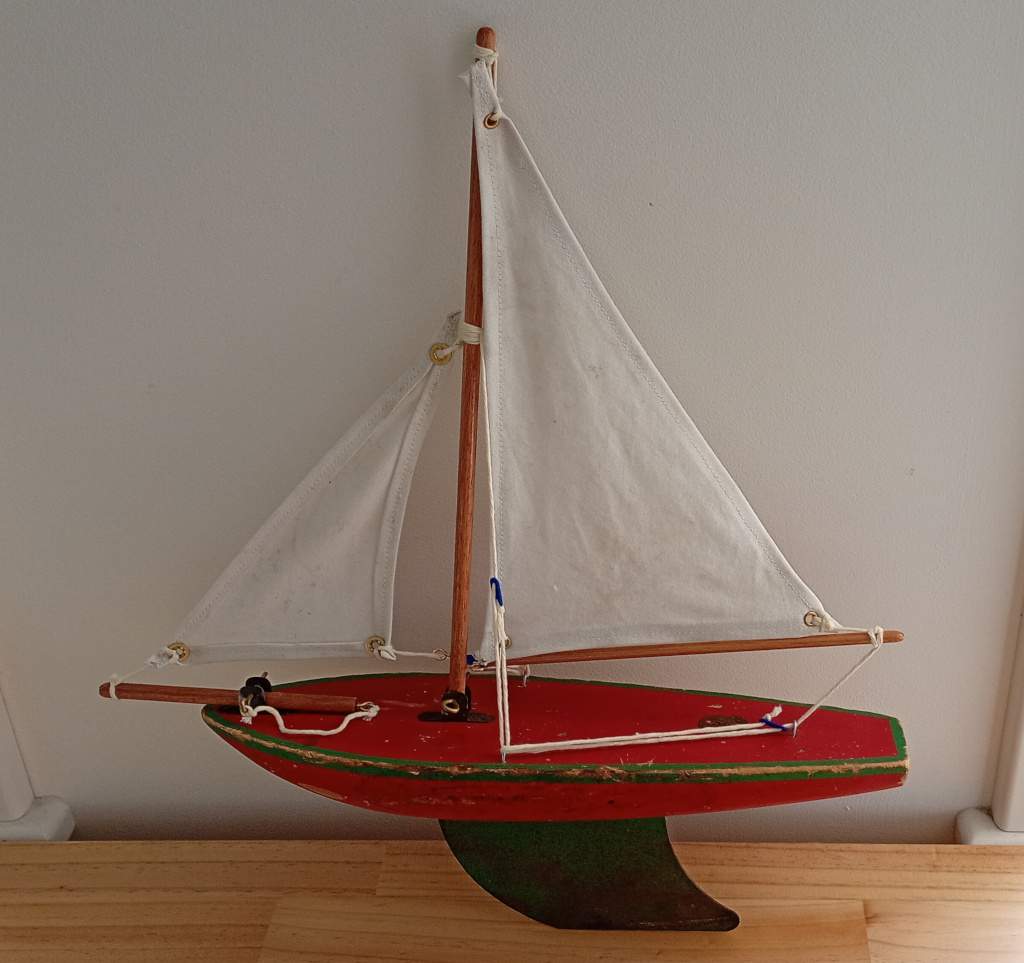
It’s odd, do you not agree, how one thing can lead to another in the most unlikely way until you get to an end point that has nothing to do with the originating event. A fortnight ago I went up to clean the solar panels and now I have rebuilt my toy yacht. How? I hear you ask.
Simple. The PV system broke down, so we needed to get it looked at; the electricians came and said “Oo, sorry guvnor, looks like you need a new system. The garage is the best place for the inverter.”; I spent a day moving my junk out of boxes in the back shed into the filing cabinet and the wardrobe, then moving junk from the garage into the back shed so there was room for a solar installation; I brought a whole lot of treasures into the house including the hull of my yacht; I looked at it and thought “It’s time I did something about that.”
So after 40 years I finally got around to rebuilding my yacht.
It was in pretty bad shape, in fact the hull is still pretty battered. I considered stripping it back to bare wood, filling the dents, repainting and so on but looking at it I decided to leave it as is and add some new fittings. Granted, a coat of clear epoxy wouldn’t go amiss but I’s still have to deal with the keel which is made of steel and a little rusty. I know there are treatments that you can add over the top of distressed metal but that’s likely an expensive proposition.
First I tried getting the mast mount and bowsprit retaining brackets off, because they were bent and rusty but they proved surprisingly difficult to move. Not wanting to damage the hull any more than it was, I chose to straighten up the brackets and rub off the surface rust as best as I could. I was unhappy with the state of the deck staples; they were particularly rusty, with the remnants of the copper wire I had used for rigging as a child.
At about this point I discovered www.birkenheadstaryachts.co.uk which is a museum dedicated to the brand. They have a comprehensive library of information about the yachts including tutorials on manufacturing parts and rebuilding. For the remainder of the build I referred closely to the notes from this site, so thanks to F.J.Denye. Browsing the website I discovered that my yacht is an SY-3 from the 1980’s, which would be right about the time I was splashing about in the dam with it.
So I went to Bunnings to get some dowel, screw eyelets, nails and probably something else. I pulled out the original deck staples and bent a few 40 x 1.5 bullet head nails to the right shape, following the tutorial from BSYAS. I fitted them in the original holes without issue. Then I needed some retaining pins for the mast and bowsprit. I didn’t have the brass wire needed for the job but I managed to bend up some stainless steel wire from my old model plane that recently went to the tip 🙁
The pins worked, but they were too narrow and kept slipping out. I replaced them with a pair of pins I made from some old brazing wire. The brazing wire was just as difficult to bend and it’s probably a bit heavy for the application. Perhaps I’ll keep my eye out for some brass wire.
Then I set about making the mast, bowsprit and boom. Following the dimensioning guide from BSYAS, I cut the dowels to length, rounded them off and drilled them. To position the holes for the screw eyelets in the ends of the boom and bowsprit, I put those pieces into the lathe and drilled them out with a 1mm drill. Instead of making a wire goose head for the mast, I installed a screw eyelet on either side. I attempted to use another screw eyelet in the end of the boom to join it to the mast, but that meant there was no hook to retain the bottom corner of the mainsail. I took a length of stainless steel wire (again from the plane) and made the boom goose head. That worked well with the screw eyelet in the mast.
After a couple of coats of varnish, the woodwork was ready for installation.
Because of the heavy gauge of the retaining pins, I had no easy way of bending over the mast pin to stop it from falling out. There’s enough friction for that not to be an issue but I wanted to be sure. I used a push-on nylon motor spindle thingy that I have dozens of to make sure that the mast pin can’t escape. I’m thinking of getting some brass rod to do the job right.
I also had to make some sails. I had seen a piece of heavy brown cotton while mucking about in the garage that I catalogued as being “a good bit of cloth”, but there was also a sizeable scrap of white cotton cloth from a shirt or something that was banging around and had not gotten too filthy. I told mum that I needed to use the sewing machine and took it downstairs. Well, I haven’t used a sewing machine since high school. Plus there was no instructions. Hunting around online was largely fruitless with numerous sites all hosting non-downloadable versions of the manual. One site even wanted to charge me $3.00 for the pdf. That’s when I did what I should have done in the first place and went straight to the Elna global website and had a manual in moments.
After about 45 minutes of reading the manual and examining the machine, I figured I had a rudimentary grasp of the machine. I cut out a little scrap of cloth and ran it through the machine. Everything seemed to work. I then cut out a triangle and tried sewing some hems. The main difficulty, alright, one of the many difficulties, was trying to finish off the hem at a corner, because the machine has difficulty driving the cloth back when it’s pointed, so it bunches up. Anyway, I wanted to have a go at doing a proper sail but I needed the pattern. There was a pattern on birkenheadstaryachts.co.uk but it wasn’t to scale. I drew up the pattern in Inkscape and printed it out, then used that as a template on the cloth. Getting the hems to fold over was bothersome because the cloth kept unfolding. I used pins but, eh, it worked out fine.
I wanted to add eyelets to the sails so I had a go at that. I have a little eyelet tool but it always simply crushes the eyelets, so it’s obviously not the right tool to use. Looking online I discovered that eyelet pliers were a thing and suddenly remembered that I already had a pair. I hauled them out and they seemed to work okay, but still the eyelets were being deformed. It was only when I tried fitting washers to the eyelets that they installed properly. Anyway, washers was the other thing I had bought at Bunnings. I needed to drill them out to fit over the eyelets and the outer diameter is a bit aggressive but the only other solution would have been to hunt all around town.
Well I made the sail and it looked pretty good, except that the hems were folded only once, so the raw edges were still visible. I cut out some cloth from the white cotton, making sure to leave a wide allowance for the hem. Then I struggled to fold the hem over and then over again. I don’t know how people do it, but I sort of solved the problem with glue, then pins and ironing. This was not entirely successful because it was hard to fold on the straight line without ending up with a curve. In the end I produced a jib sail that isn’t as tidy as my test sail but it does have double folded hems.
I repeated the procedure to make the main sail, arguably with slightly better results. I made one boo boo though. I didn’t flip the cloth over when making the hems, so the eyelets face different directions on the jib and main sail. It’s not terrible but it could have been better.
The next thing to make were the bowsies, as they are known; little plastic things with two holes that you use to adjust the length of the rigging ropes, you see them on tent strings too. The instructions were to make them from 1mm plasticard. Well I don’t have plasticard, but I do have a 3D printer. I copied the measurement from the tutorial and modeled the design in Blender. After printing them out I discovered that they were just a bit small. Not wanting to drill them out I increased the width to 6mm and the hole diameters to ca. 2.5mm. On the second print they came out pretty much perfect. I might have liked them in red, but I already had the blue filament open so blue it was.
I guess the last bit was the actual rigging. I’d gone down to the supermarket to get some string but realised it probably wasn’t right for the job, so later in the day I went back to Bunnings and got some shop twine which also doesn’t seem like the right material. I’d actually like some woven string instead of the loosely spun string. Putting that aside, I followed the rigging instructions carefully and in about an hour or so the yacht was back together. To thread the string through the holes in the woodwork and the bowsies, I used a loop of thin copper wire to capture the string and pull it through. Making the knots was a bit of trial and error and probably more error. As expected I did have some difficulty with the string becoming unspun, leading to the final result not looking as tidy as it might have.
But after decades, my little yacht is re rigged and maybe it suffers from PTSD and stares into the mid distance remembering the stuff it’s seen, man, but it looks a lot better than it did a few days ago.
Thoughts.
Somehow I imagined the job of repairing the yacht would be a lot simpler that it was. Sure it only took a few days – a week at most – but this is not a full restoration. It’s a bare minimum refit and still I needed a whole workshop of tools to do the job.
The result is, well it’s a bit of a Frankenstein of a job. Don’t get me wrong, it’s great to have it back together but you can tell it’s been put together from ever so slightly mismatched components that have been scavenged from boxes of junk, from the oversized retaining pins, to the slightly scruffy rigging string, to the retaining washers being slightly too large. Perhaps the best way to look at it is this is a starting point and maybe I can continue to work on the yacht from time to time. You know, maybe I could go into Spotlight and find some nice cord to use to redo the rigging. Maybe I’ll cut out another bit of cloth and sew up another jib (done) and put the hems on the right side. Maybe I’ll order some brass wire of the correct gauge. Maybe I’ll make a stamp and put the Star logo on the main sail – that’s something I would like to have a go at.